
Personal Update and Thoughts on the Creative Process
Yo helmsman, spin that wheel.

“The way that can be described is not the eternal Way.
The name that can be named is not the eternal Name.
The Unnameable is the source of the Universe.
The Nameable is the source of all things within the Universe.
Contemplate the Way for its own sake and you will see the mystery.
Contemplate the Way for a purpose and you will see the effects.
Mystery and effects spring from the same Source.”
~ Lao Tzu, The Tao Te Ching
Firstly, my apologies, dear readers, for a somewhat lengthy absence. The tripartite structure of my life - health, relationships and interests - required significant attention over the previous few months; mostly relationships and interests, although neglecting those can inevitably impact the former unless an appropriate balance is maintained. Hopefully I have been diligent enough in this regard.
One of the problems I’ve been grappling with is probably familiar to most, if not all of you in this day and age - the problem of Too Much Information (TMI). Anyone who is paying even the slightest attention to “whatever it is that exists outside of ourselves,” as Iain McGilchrist so poetically put it, has no doubt noticed that “whatever” seems to be increasingly chaotic and, dare I say, even hyperkinetic, of late. From flagrant genocide, to wars distractive of celestial intentions, to political brinksmanship and upheaval, to see-sawing financial markets, to daily technological quantum leaps, not to mention the ‘rocking and rolling’ of Mother Earth that is increasingly starting to resemble a death metal concerto (recent guest musician: Sol the Flaring Wonder in maximum auroral volume mode); you only need to open up TwiXer or Telegram to get sucked into a vortex of information that can sideline hours of your time on a daily basis.
Then, should you possess the presence of mind not to devote all your daily portion of attention and energy to Current Thingness, there’s a million libraries worth of knowledge that can be sampled in nearly as many specialities to cater to your burning questions du jour. Plus, there are always those annoying mosquitos generally referred to as jobs and income (genetically-enhanced courtesy of psychopathic idiot savants such Bill Gates and his human-divergent elitist kin) and should you happen to be one of those (heaven forbid) reproductively-sound heterosexual creators of progeny, there’s the attendant responsibilities of family to go with the wider duties to clan and tribe.
Sometimes, ya just gotta go offline for a bit.
If you’re anything like me though, insistent questions tend to thrive and multiply quite quickly once a minimum of sufficient downtime has been achieved, and then the siren call of the Screen seductively whispers… “Maybe just some reading, look at how many fascinating books you’ve got on the Kindle! And if you need to look up a word or particular concept… well, surfing the web is always so educational! Wikipedia contains such a tantilising number of links, doesn’t it? Or is reading a bit tiresome today? How about that... a new philosophy podcast episode just dropped! You can enjoy the audio version from the comfort of the lounge! And you haven’t done your daily DuoLingo language lesson yet… oh! A push notification! However did THAT get there? Well, you’ve seen the headline now, might as well just take a quick peek!”
Away from me, ye accursed! I summon the angels of The Outdoors, Exercise and Human Contact to silence thy endless chattering!
Sometimes the cravings can be fulfilled via those legacy paperware apps that are so satisfyingly touchable; there are apparently advantages to such methods of info-similation that may even surpass a Matrix-style brain jack in the back of the skull. Who’d’ve thunk? Eventually, the Screen seems to become a necessary evil once again though, so the question then arises, how can such a recurring daemon be made most efficiently able to work for the glory of God?
The answer, like many answers (although not all), can be found within ourselves. In my case, Converging Events of the Inconvenient Variety prompted a little soul-searching about a particular behavioural pattern that had already consumed far more than its fair share of my attention and energy. It went something like this: Make money to get more free time, use a portion of that time to find better ways to become financially secure, so that I can guarantee the availability of that free time, and then use the other portion to work towards larger aims. The crux of the problem was that I wasn’t really considering the nature of that other portion, in so much as what I love to do creatively, and the more I thought about that in terms of removing the "make more money" and "find more free time" aspects, the more I was increasingly puzzled about what it was I actually enjoyed enough to focus on.
This Substack is a good example. I enjoy writing, however from the beginning I was approaching this endeavour with certain fixed goals in mind, some that I’m sure many authors can relate to: “write good stuff”, “cultivate an audience”, “profit”, “leverage profit into free time”. To cultivate an audience requires a lot of good content (although that could be very plausibly argued against these days) and regular good content at that. Creativity is not about regularity though; you can’t summon it up on a schedule.
Although pursuing fixed goals seems to be a fool’s errand, I nonetheless started to think in systematic terms about a process I could use to “generate content”. 1) Write down ideas as they occur, for later development. 2) Read all about those ideas. 3) Create posts that would methodically explain those ideas, citing sources and referencing examples.
I found the main problem with this was that I was generating ideas far faster than I could methodically research and explain them, winding up with tons of notes that then made my reading list even bigger than it already was. Some of those ideas needed more than a fortnight to be properly thought through, let alone written down into something coherent and enjoyable enough for others to allocate valuable attention to reading.
Then there’s also the “gimmick factor”. If you want to make something enjoyable to an audience, it’s difficult not to begin to think up and rely on gimmicks as a means to attract attention, even if you are trying to be as authentic as possible. Relying on them then starts to fill up your ‘creative attention space’ with recurring tasks that lack any sense of real personal connection, because you then mechanistically ‘go through the motions’ for clicks, not discovering something that is as intrinsically personal, free-flowing and growth-cultivating as it is entertaining.
The Zen saying about ‘emptying one’s cup’ before one can be taught anything seems to be an ongoing process that never truly ends, although doing it for the first time can be an event of heightened personal significance. This seems to apply also in the sort of Master-Emissary dynamic1 that evolves continually between the two primary hemispheric perspectives. The Left Hemisphere continually ‘fills its cup’ with all kinds of knowledge gained through the intuitive promptings of the Right Hemisphere, and then needs to ‘empty its cup’ by disposing of paradoxes and handing the enriched, consistent knowledge back to the Right Hemisphere so that the next quantum of information can be received and considered.
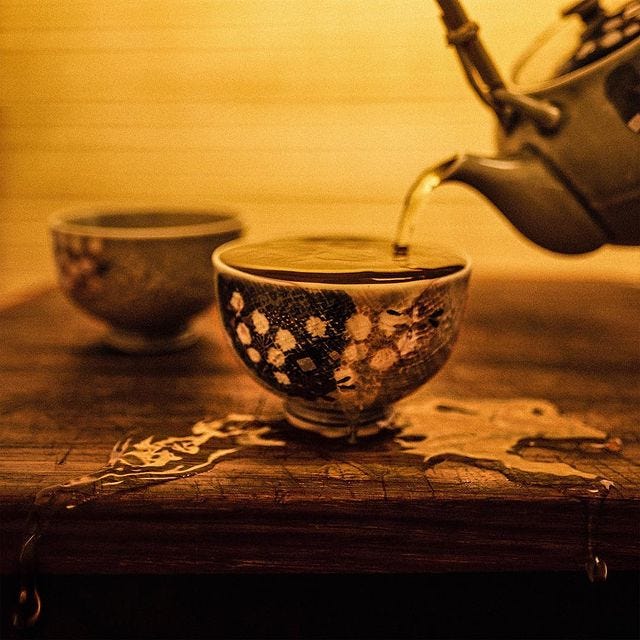
Where the process can get stuck is in the Left Hemisphere’s recalcitrance to ‘empty its cup’. It seems to be more than happy to keep on filling its cup to the point of schizophrenia, and in extremely pathological cases attempts to find ways to magically expand its cup larger and larger for all eternity so that it can contain all knowledge and never overflow; something fundamentally impossible, because the Right Hemisphere, seeing a more holistic picture, knows that all the Knowledge of the Universe is far too much for any one brain to grasp.
Current Thingness seems to feed into that left-hemispheric mentality of continuous cup-filling without the requisite cup-emptying, leading to TMI and hampering the creative process in both obvious and less-obvious ways, so focusing less on such events and the insistent urge to ‘do something’, even making the conscious choice to do nothing, seems to be a good way to bootstrap out of linear ‘task’ mode, and into creative ‘play’ mode.
Of course, ‘doing nothing’ can be a lot more difficult than it looks sometimes, and the next best option is usually to sublimate that left-hemispheric nervous energy into active leisure, or at the very least, constructive physical activity like exercise. What seems to be important is taking the mind off that ‘goal’ with its promise of sweet dopaminergic rewards, and disposing the attention nearly anywhere else.
“But what’s the problem with goals?” I hear you ask. “Isn’t it important to accomplish the tasks we set for ourselves?”
Yes and no. Although I haven’t yet read Atomic Habits2 which apparently deals with this problem in more depth, the concept of a goal is fundamentally linked to boundaries, limits and in the modern sense, usually ‘time’. From Etymonline.com:
1530s, "end point of a race," of uncertain origin. It appears once before this (as gol), in a poem from early 14c. and with an apparent sense of "boundary, limit." Perhaps from Old English *gal "obstacle, barrier," a word implied by gælan "to hinder" and also found in compounds (singal, widgal). That would make it a variant or figurative use of Middle English gale "a way, course." Also compare Old Norse geil "a narrow glen, a passage." Or from Old French gaule "long pole, stake," which is from Germanic. Sports sense of "place where the ball, etc. is put to score" is attested from 1540s. Figurative sense of "object of an effort" is from 1540s.
In other words, a goal can be seen as a limit, boundary or hindrance on the passage or way we are following. Doesn’t it make sense then that, rather than seeking to pursue goals intentionally, we should deal with them as they naturally arise or occur? In other words, simply do what is in front of us to do, each day, without anticipation of results or rewards?
Not pursuing goals doesn’t imply aimless drifting, though. If we don’t maintain a conscious course of some sort in our lives then we inevitably end up going in circles, or worse, spiraling down into oblivion. Navigation is necessary, indeed crucial, and requires no small amount of self-discipline. In whatever direction we journey, there will be goals, because goals are ‘punctuators’ of progress along the way, but if a particular direction and its goals are not bringing sufficient fulfillment, joy and meaning into our lives, it may be necessary to make a ‘course correction’.
Yet such course corrections should not be taken lightly either, as there’s a faith of a certain sort at work here as well. The sort of faith that doesn’t know the exact parameters or shape of the destination, yet deeply trusts that everything will turn out okay, as long as one holds true to their direction while also staying vigilant to the signs and conditions along the way. Which can be the crux of the matter, as the most direct route may not be a navigable one. Sometimes a detour is necessary.
Are we paying attention to objective reality, right and left? What are the experiences of our life within the interactive Universe communicating to us? Are we still on the Way, heading in the right direction?
In the case of this ‘stack, I have decided to remove publishing deadlines. I will attempt to publish regularly, but with the focus now less on periodicity and more on quality.
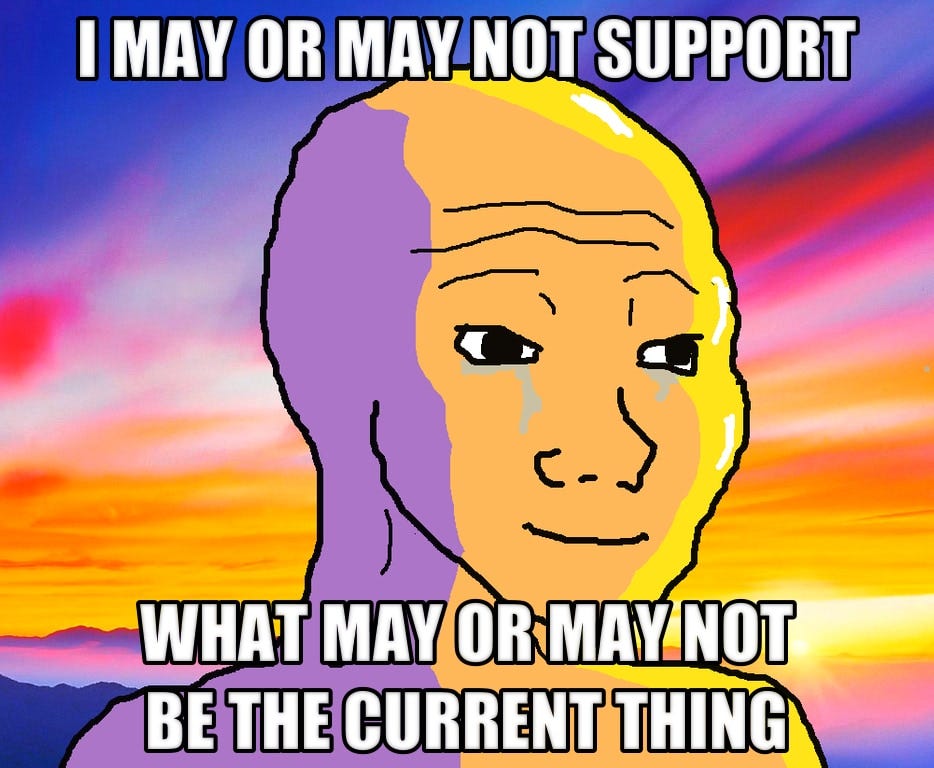
I will also attempt to focus less on Current Thingness and also Future Thingness (ie. speculation and prediction), although sometimes a little Current and Future Thingness can be useful for explanatory purposes. It will depend on the context; as I wrote in the header meme: I may or may not support what may or may not be the current (or future) thing.
I also plan on accepting donations, although I’m not sure about subscriptions yet. The concept of a subscription seems a little too related to ‘time’ for my liking.
“What’s your beef with time?” you may ask. Well that, my friend, is a subject for another post. Let’s just say for now that quantum physics seems to be moving in a direction that indicates time may be not be any sort of objective phenomenon à la General Relativity, but rather an artifact of our perception.
So, money be damned. Time be damned. Let’s just explore some out-there ideas and have some fun.
R.

If you enjoyed my article or found it interesting, why not share the love? Or, if you haven’t already, you can
Thanks for reading!
McGilchrist, Iain, The Master and His Emissary, (New Haven, Connecticut: Yale University Press, 2019 Expanded ed.)
Clear, James, Atomic Habits, (London, United Kingdom: CENTURY - TRADE, 2018 First ed.)